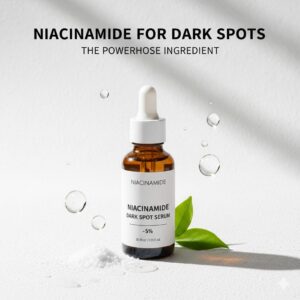
Niacinamide for Dark Spots:
If you’ve spent any time reading skincare labels lately, you’ve probably seen niacinamide everywhere. It’s in your moisturizer, your serum, your toner, maybe even your sunscreen. Beauty brands can’t shut up about it, influencers rave about it, and dermatologists actually recommend it—which, if you know anything about skincare, is rare.
But here’s what nobody’s telling you in those 30-second TikTok videos: niacinamide is probably the most versatile, well-researched, and underrated ingredient for treating dark spots. Not the fastest, not the strongest, but possibly the smartest choice you can make.
I’m not exaggerating. After spending weeks digging through clinical studies, testing different formulations, and talking to people who’ve actually used it, I’m convinced that if you could only pick one ingredient to treat hyperpigmentation, niacinamide should be in your top three.
Let’s talk about why.
What Actually Is Niacinamide?
Niacinamide is a form of vitamin B3 (niacin). Your body actually needs it to function—it’s involved in hundreds of metabolic processes, including energy production and DNA repair. When you eat foods like meat, fish, nuts, and grains, you’re getting niacin, which your body converts into niacinamide.
But here’s where it gets interesting for skincare: when you apply niacinamide topically (directly on your skin), it does things that eating it can’t accomplish. It penetrates your skin cells and gets to work on multiple levels simultaneously.
Unlike ingredients that do just one thing—fade dark spots OR reduce oil OR strengthen your barrier—niacinamide does all of it. And it does it without the irritation, sensitivity, or drama that comes with stronger actives like retinol or acids.
The scientific name you might see on ingredient lists is “nicotinamide,” but don’t let that confuse you. Niacinamide and nicotinamide are the same thing. Same ingredient, different names.
The Science Behind Niacinamide and Dark Spots
Okay, let’s get into the actual mechanisms. How does niacinamide fade dark spots?

It Blocks Melanin Transfer
Here’s something most people don’t know: your skin is constantly producing melanin (the pigment that gives skin its color). That’s normal. The problem isn’t melanin production—it’s when melanin gets transferred from melanocytes (the cells that produce it) to keratinocytes (your regular skin cells) in excessive amounts or uneven patterns.
A 2002 study published in the British Journal of Dermatology found that niacinamide reduces the transfer of melanin from melanocytes to keratinocytes by 35-68%, depending on the concentration used. Think of it like this: melanin is still being made, but it’s not moving into your visible skin cells where it causes dark spots.
This is different from ingredients like kojic acid or hydroquinone, which stop melanin production entirely. Niacinamide just regulates the process, which is why it’s so much gentler.
It Accelerates Cell Turnover
Your skin naturally sheds dead cells and replaces them with new ones. This process is called cell turnover, and it typically takes about 28 days in young adults (longer as you age).
Niacinamide speeds this up. When your skin turns over faster, those pigmented cells sitting on the surface get shed more quickly, revealing fresher, lighter skin underneath.
Multiple studies have shown that niacinamide increases keratinocyte differentiation and turnover without causing the irritation and sensitivity that comes with traditional exfoliants like AHAs or retinoids.
It Has Anti-Inflammatory Properties
This is huge, and it’s often overlooked in discussions about hyperpigmentation.
Inflammation triggers melanin production. Every time your skin gets inflamed—from acne, irritation, sun exposure, even aggressive skincare—your melanocytes go into overdrive. This is why that pimple from two months ago is still leaving a dark mark. That mark isn’t leftover acne; it’s post-inflammatory hyperpigmentation (PIH).
Niacinamide is a potent anti-inflammatory. It reduces the inflammatory cascade that leads to excess pigmentation in the first place. A 2005 study showed that 4% niacinamide reduced inflammatory markers by up to 60% after just four weeks.
So while other ingredients are treating the dark spots you already have, niacinamide is also preventing new ones from forming.
It Strengthens Your Skin Barrier
Your skin barrier is the outermost layer that protects you from environmental damage, bacteria, and water loss. When this barrier is compromised—from over-exfoliation, harsh products, environmental stress—your skin becomes more prone to inflammation, which (as we just discussed) leads to hyperpigmentation.
Niacinamide increases ceramide production in your skin. Ceramides are lipids (fats) that make up about 50% of your skin barrier. More ceramides = stronger barrier = less inflammation = less hyperpigmentation.
It also increases the production of other barrier components like free fatty acids and cholesterol. Think of it as reinforcing all the weak points in your skin’s protective wall.
It’s an Antioxidant
Free radicals from UV exposure, pollution, and stress damage your skin cells and accelerate aging—including the formation of dark spots and uneven pigmentation.
Niacinamide is an antioxidant. It neutralizes free radicals before they can cause damage, protecting your skin from the environmental factors that lead to hyperpigmentation.
This is preventative brightening—stopping dark spots before they form rather than just treating existing ones.
Niacinamide vs. Other Brightening Ingredients
Let’s be honest: niacinamide isn’t the fastest or strongest brightening ingredient. But it might be the smartest.
| Ingredient | Brightening Power | Speed | Gentleness | Additional Benefits | Best For |
|---|---|---|---|---|---|
| Niacinamide | Moderate-Strong | Moderate (4-8 weeks) | Extremely gentle | Barrier repair, oil control, anti-aging, pore minimizing | All skin types, daily use |
| Kojic Acid | Strong | Fast (2-4 weeks) | Can irritate | Focused on pigmentation only | Stubborn spots, not sensitive skin |
| Alpha Arbutin | Moderate | Moderate (4-6 weeks) | Very gentle | Focused on pigmentation | Sensitive skin, maintenance |
| Vitamin C | Strong | Moderate (4-8 weeks) | Can irritate | Antioxidant, collagen production | Anti-aging + brightening |
| Turmeric | Moderate | Slow (6-8 weeks) | Very gentle | Anti-inflammatory, antioxidant | Natural approach, inflammation |
| Hydroquinone | Very Strong | Fast (2-4 weeks) | Harsh, prescription | Focused on pigmentation only | Severe hyperpigmentation (short-term) |
What makes niacinamide unique is the combination of effectiveness + gentleness + multiple benefits. You’re not just treating dark spots—you’re improving your entire skin health.
Real Results: What to Actually Expect
Let me set realistic expectations because the before-and-after photos you see on Instagram are usually showing best-case scenarios (or filters).
Timeline for Visible Results
Week 1-2: Your skin might feel smoother and look slightly more radiant. This is from the barrier-strengthening and anti-inflammatory effects. Dark spots won’t be lighter yet, but the redness around them might decrease.
Week 3-4: You should start seeing subtle evening of skin tone. The areas around your dark spots look brighter, which makes the spots themselves less prominent. If you have oily skin, you might notice less shine and smaller-looking pores.
Week 6-8: This is when measurable improvement happens. Dark spots should be noticeably lighter (not gone, but lighter). Overall skin tone is more even. Post-acne marks are fading.
Week 12+: Significant improvement in hyperpigmentation with consistent use. Dark spots continue to fade. Skin texture is smoother, pores less visible, and your complexion looks more balanced overall.
What Niacinamide Can Realistically Treat
Works excellently for:
- Post-inflammatory hyperpigmentation (PIH) from acne
- Mild to moderate dark spots
- Overall uneven skin tone
- Redness and inflammation
- Dark spots combined with other skin concerns (oily skin, large pores, fine lines)
- Prevention of new dark spots
Works moderately for:
- Melasma (better in combination with other actives)
- Sun damage and age spots
- Moderate to severe hyperpigmentation (you’ll see improvement, but slower)
Doesn’t work well for:
- Very deep, old dark spots (10+ years old)
- Birthmarks or congenital pigmentation
- Vitiligo (this requires medical treatment)
Who Sees the Best Results?
Niacinamide works for literally everyone, but certain people see particularly impressive results:
Best candidates:
- People with recent hyperpigmentation (less than 2 years old)
- Those with sensitive skin who can’t tolerate stronger actives
- Anyone dealing with multiple skin concerns (dark spots + acne + oily skin + aging)
- People with compromised skin barriers
- Those looking for long-term maintenance after treating severe hyperpigmentation
- Anyone who wants gentle, consistent results without irritation
The beauty of niacinamide: It works on all skin types and tones. Unlike some brightening ingredients that work better on certain Fitzpatrick types, niacinamide is universally effective.
How to Use Niacinamide for Dark Spots
Concentration Matters
Here’s something important: not all niacinamide products are created equal.

The research:
- Most clinical studies use 2-5% niacinamide
- 2% shows visible benefits for hyperpigmentation
- 5% shows optimal results for most people
- 10% doesn’t necessarily work better (and might irritate some people)
What this means for you:
- Look for products with 4-5% niacinamide for dark spots
- 2% is fine for maintenance or sensitive skin
- 10% products can work, but start with lower concentrations first
How to check concentration: If the percentage isn’t listed on the label, look at the ingredient list. If niacinamide is in the first 5 ingredients, it’s likely at an effective concentration (2%+). If it’s near the end, it’s probably too low to make a difference.
Step-by-Step Application
Morning Routine:
- Cleanse with a gentle, pH-balanced cleanser
- Tone (optional, but helps with absorption)
- Apply niacinamide serum (2-3 drops, pat gently into skin)
- Wait 1-2 minutes for absorption
- Apply other serums if using (vitamin C, hyaluronic acid)
- Moisturizer
- SPF 30-50 (non-negotiable—sun exposure undoes brightening)
Night Routine:
- Double cleanse (oil cleanser first, then water-based)
- Tone
- Apply niacinamide serum
- Wait 2-3 minutes
- Apply other actives (retinol, AHAs—more on this below)
- Moisturizer or night cream
How often: Daily, both morning and night. Niacinamide is gentle enough for twice-daily use.
Product Formats:
Niacinamide comes in different formulations. Here’s what works best:
Serums (Most Popular & Effective):
- Highest concentration of niacinamide
- Lightweight, absorbs quickly
- Layer easily under other products
- Best for targeted dark spot treatment
Moisturizers with Niacinamide:
- Good for maintenance and prevention
- Usually lower concentration (1-3%)
- Combines hydration with brightening
- Best for people who want simplicity
Toners with Niacinamide:
- Preps skin for better absorption of other products
- Usually lower concentration
- Good addition to a routine but shouldn’t be your only niacinamide source
All-in-One Products:
- Products that combine niacinamide with other actives
- Can be effective if well-formulated
- Good for minimalist routines
My recommendation: Use a dedicated niacinamide serum (4-5%) for dark spots. If your moisturizer or toner also has niacinamide, that’s a bonus, but the serum should be your primary source.
Can You Mix Niacinamide with Other Ingredients?
This is where people get confused, and honestly, the internet has spread a lot of misinformation about this.
The Vitamin C Myth
You’ve probably heard that niacinamide and vitamin C can’t be used together. This is outdated information based on old research.
The truth: Modern formulations are stable. You can absolutely use niacinamide and vitamin C together. In fact, they work synergistically—both are brightening and antioxidant, just through different mechanisms.
How to use them together:
- Option 1: Vitamin C in the morning, niacinamide at night
- Option 2: Apply vitamin C first, wait 5-10 minutes, then apply niacinamide
- Option 3: Use products that contain both (many now do)
The only potential issue is if you’re using pure L-ascorbic acid (the strongest form of vitamin C) at very low pH. In that case, wait 10-15 minutes between applications to let your skin’s pH stabilize.
Great Combinations
Niacinamide + Retinol: Excellent combo. Niacinamide actually buffers retinol’s irritation while enhancing its effects. Use niacinamide first, then retinol.
Niacinamide + AHAs/BHAs: Safe and effective. The anti-inflammatory properties of niacinamide help counteract potential irritation from acids. Apply niacinamide after your acid treatment.
Niacinamide + Alpha Arbutin: Perfect pairing for gentle brightening. Both work through different mechanisms, no interactions. Apply either first.
Niacinamide + Kojic Acid: Good combination. Niacinamide soothes any irritation from kojic acid. Apply niacinamide first.
Niacinamide + Turmeric: Excellent anti-inflammatory and brightening duo. No conflicts. Use niacinamide serum, then turmeric products.
Niacinamide + Azelaic Acid: Another great combo for hyperpigmentation and acne. Both are gentle and complementary.
Niacinamide + Hyaluronic Acid: Perfect together. Hyaluronic acid provides hydration, niacinamide strengthens the barrier and treats dark spots.
What to Avoid
High-pH products immediately after niacinamide: Can reduce effectiveness. Wait 5-10 minutes.
Too many actives at once: While niacinamide plays well with others, don’t pile on 6 different actives. Your skin needs balance.
Sample Routines for Different Skin Types
For Oily/Acne-Prone Skin with Dark Spots
Morning:
- Salicylic acid cleanser
- Niacinamide serum (5%)
- Lightweight gel moisturizer
- Oil-free SPF 50
Night:
- Oil cleanser (yes, even for oily skin)
- Salicylic acid cleanser
- Niacinamide serum
- BHA treatment (2-3x per week)
- Gel moisturizer
Why this works: Niacinamide regulates oil production while fading post-acne marks. BHA treats active acne.
For Dry/Sensitive Skin with Dark Spots
Morning:
- Gentle cream cleanser
- Hydrating toner
- Niacinamide serum (2-4%)
- Hyaluronic acid serum
- Rich moisturizer with ceramides
- Mineral SPF 30+
Night:
- Cleansing balm
- Gentle cream cleanser
- Hydrating toner
- Niacinamide serum
- Facial oil or rich night cream
Why this works: Lower concentration niacinamide provides brightening without any risk of irritation. Barrier-strengthening focus helps prevent inflammation-triggered pigmentation.
For Combination Skin with Stubborn Dark Spots
Morning:
- Gentle foaming cleanser
- Vitamin C serum
- Niacinamide serum (5%)
- Lightweight moisturizer
- SPF 50
Night:
- Double cleanse
- Alpha arbutin serum
- Niacinamide serum
- Retinol (start 2x per week, build to nightly)
- Moisturizer
Why this works: Layering multiple brightening actives (vitamin C, alpha arbutin, niacinamide, retinol) for stubborn pigmentation. Niacinamide buffers potential irritation.
For Mature Skin with Sun Damage
Morning:
- Gentle cleanser
- Vitamin C serum
- Niacinamide serum (5%)
- Peptide moisturizer
- SPF 50 (most important step)
Night:
- Double cleanse
- Niacinamide serum
- Retinol or tretinoin
- Rich moisturizer
- Facial oil (optional)
Why this works: Addresses both dark spots and aging. Niacinamide + vitamin C + retinol is the gold standard anti-aging + brightening combo.
Side Effects and Safety
One of niacinamide’s biggest advantages is how safe it is. But let’s cover potential issues anyway.
Common “Side Effects”
Temporary flushing or warmth: Some people experience mild flushing when they first start using niacinamide. This is actually from niacin (the precursor) and usually goes away within 20-30 minutes. Not harmful, just slightly annoying.
Purging (rare with niacinamide): Unlike retinol or acids, niacinamide doesn’t typically cause purging. If you’re breaking out after starting niacinamide, it’s more likely a reaction to another ingredient in the product or a coincidence.
Slight tingling: Normal, especially if you’re using it with other actives. Should subside quickly.
Actual Side Effects
Niacinamide sensitivity: Very rare, but some people react to niacinamide with redness, irritation, or breakouts. This is more common with concentrations above 10%.
Contact dermatitis: Extremely rare. If you develop a rash, hives, or severe irritation, discontinue use.
Who Should Be Cautious?
Most people can use niacinamide without issues, but:
⚠️ If you have rosacea: Start with 2% concentration. Higher amounts might trigger flushing in some people (though many find niacinamide actually helps rosacea).
⚠️ If you’re using 10%+ concentrations: Start slowly. High concentrations can irritate sensitive skin.
⚠️ If you’re on niacin supplements: You’re already getting plenty of vitamin B3 internally. Topical niacinamide is still fine, but be aware of the total intake.
Patch Test If You’re Worried
- Apply a small amount to your inner forearm
- Wait 24 hours
- Check for redness, itching, or irritation
- If clear, test on your jawline
- Wait another 24 hours
- If still fine, proceed with full face application
Honestly, though, niacinamide is one of the safest actives you can use. The risk of a bad reaction is extremely low.
The Mistakes People Make with Niacinamide
Despite how straightforward niacinamide is, people still mess it up. Here’s what to avoid:
Mistake #1: Using Too Little
That toner with niacinamide listed as the 12th ingredient isn’t going to fade your dark spots. You need at least 2%, ideally 4-5%.
Fix: Use a dedicated niacinamide serum with a stated percentage.
Mistake #2: Expecting Overnight Results
Niacinamide works, but it works gradually. If you give up after two weeks because you don’t see dramatic change, you’re quitting right before it starts working.
Fix: Commit to 8-12 weeks of consistent use before evaluating results.
Mistake #3: Skipping Sunscreen
This isn’t specific to niacinamide, but it bears repeating: NO brightening ingredient works if you’re not wearing SPF daily. UV exposure creates new pigmentation faster than any active can fade it.
Fix: SPF 30-50 every single morning. Non-negotiable.
Mistake #4: Not Addressing the Root Cause
If your dark spots are from hormonal melasma, niacinamide will help, but you also need to address the hormonal component. If they’re from picking at acne, niacinamide will fade the marks, but you need to stop picking.
Fix: Treat the underlying cause while using niacinamide for the pigmentation.
Mistake #5: Using Expired or Improperly Stored Products
Niacinamide is stable, but it can degrade over time, especially if exposed to heat and light.
Fix: Store products in a cool, dark place. Check expiration dates. If your niacinamide product smells off or changes color, toss it.
Mistake #6: Combining with Too Many Actives at Once
Niacinamide is gentle, but if you’re also using retinol, vitamin C, AHAs, BHAs, and three other actives, your skin might get overwhelmed.
Fix: Build your routine gradually. Introduce one active at a time, wait 2-3 weeks, then add another.
Niacinamide for Different Types of Dark Spots
Not all dark spots are the same. Here’s how niacinamide works for different types:
Post-Inflammatory Hyperpigmentation (PIH)
What it is: Dark marks left after acne, injuries, or inflammation
How niacinamide helps: Reduces inflammation to prevent new PIH, blocks melanin transfer, accelerates cell turnover to fade existing marks
Timeline: 6-8 weeks for noticeable improvement
Best combined with: Gentle AHAs, retinol, sunscreen
Success rate: High (70-80% see significant improvement)
Melasma
What it is: Hormonal hyperpigmentation, usually on cheeks, forehead, upper lip
How niacinamide helps: Reduces melanin transfer, strengthens barrier, anti-inflammatory
Timeline: 8-12 weeks minimum (melasma is stubborn)
Best combined with: Tranexamic acid, vitamin C, tretinoin, strict sun protection
Success rate: Moderate (niacinamide helps but usually needs combination therapy)
Sun Damage / Age Spots
What it is: Dark spots from cumulative sun exposure
How niacinamide helps: Antioxidant protection, melanin regulation, cell turnover
Timeline: 8-12 weeks
Best combined with: Vitamin C, retinol, chemical peels, laser treatments for severe cases
Success rate: Moderate to high (depends on depth and age of spots)
Overall Uneven Tone / Dullness
What it is: Not specific spots, just lack of radiance and uneven coloring
How niacinamide helps: Evens melanin distribution, improves barrier function, brightens overall complexion
Timeline: 4-6 weeks
Best combined with: Vitamin C, gentle exfoliation
Success rate: Very high (85%+ see improvement)
Should You Take Niacinamide Supplements for Skin?
Short answer: You don’t need to for skin brightening purposes.
Here’s why:
You’re probably already getting enough niacin/niacinamide from your diet (it’s in meat, fish, nuts, grains, fortified foods). Your body converts dietary niacin into niacinamide, which circulates through your bloodstream.
But here’s the thing: when you take niacinamide orally, it gets distributed throughout your entire body—your heart, liver, brain, muscles, etc. Your skin only gets a tiny fraction.
When you apply niacinamide topically, you’re delivering it directly to skin cells at much higher concentrations than you could ever achieve through oral supplementation.
The research backs this up: Studies showing niacinamide’s benefits for hyperpigmentation use topical application, not oral supplements.
Exception: If you have a diagnosed niacin deficiency (pellagra), supplements are medically necessary. But that’s a different situation entirely.
Bottom line: Save your money. Topical niacinamide is what works for dark spots.
The Best Niacinamide Products:
I’m not going to recommend specific brands (that’s not what this guide is about), but here’s exactly what to look for when shopping:
In a Serum
Must-haves:
- 4-5% niacinamide clearly stated
- Minimal additional ingredients (the simpler, the better for beginners)
- pH between 5-7
- Dropper or pump bottle (more hygienic than jars)
Nice-to-haves:
- Zinc (helps with oil control and acne)
- Hyaluronic acid (hydration)
- Other brightening ingredients (alpha arbutin, tranexamic acid)
Avoid:
- Fragrance (unnecessary irritation risk)
- Essential oils (same reason)
- Long ingredient lists with lots of potential irritants
- Niacinamide listed far down the ingredient list (too low concentration)
In a Moisturizer
Must-haves:
- At least 2% niacinamide (1% is too low for brightening)
- Barrier-supporting ingredients (ceramides, fatty acids)
- Suitable for your skin type (gel for oily, cream for dry)
Nice-to-haves:
- Peptides (anti-aging)
- Antioxidants (vitamin E, green tea)
- SPF (if it’s a morning moisturizer)
In Other Products
Toners: Look for at least 2% niacinamide. These prep skin and provide gentle brightening.
Sunscreens: Some contain niacinamide, which is a bonus for daytime brightening + protection.
Cleansers: Honestly not the best format for niacinamide since it washes off, but won’t hurt.
Frequently Asked Questions
Q: How long does niacinamide take to fade dark spots?
Most people see initial results in 4-6 weeks, with significant improvement by 8-12 weeks. Consistency is crucial.
Q: Can I use niacinamide every day?
Yes. Niacinamide is gentle enough for twice-daily use (morning and night).
Q: Does niacinamide work on all skin tones?
Absolutely. It’s effective on all Fitzpatrick skin types (I-VI) and is particularly good for darker skin tones prone to post-inflammatory hyperpigmentation.
Q: Can I use niacinamide if I’m pregnant or breastfeeding?
Yes. Niacinamide is considered safe during pregnancy and breastfeeding. It’s actually a good alternative to retinol and hydroquinone, which should be avoided.
Q: Will niacinamide lighten my overall skin color?
No. Niacinamide doesn’t bleach or permanently lighten skin. It fades dark spots and evens tone by regulating melanin distribution, but your natural skin color remains the same.
Q: Can men use niacinamide?
Of course. Skin biology is the same regardless of gender.
Q: What percentage of niacinamide should I use for dark spots?
4-5% is optimal for most people. Sensitive skin can start with 2%. Going above 10% doesn’t necessarily increase effectiveness.
Q: Can I use niacinamide with tretinoin or prescription retinoids?
Yes, and you should. Niacinamide actually reduces retinoid irritation and enhances effectiveness. Apply niacinamide first.
Q: Does niacinamide cause purging?
No. Unlike retinoids and exfoliating acids, niacinamide doesn’t increase cell turnover enough to cause purging. If you break out, it’s likely a reaction to other ingredients.
Q: Can I layer multiple niacinamide products?
You can, but there’s no real benefit. Once you hit 5% concentration, more doesn’t equal better. One good niacinamide serum is enough.
Q: Does niacinamide work better than vitamin C for dark spots?
They work differently. Vitamin C might be slightly faster, but niacinamide is gentler and has more additional benefits. Using both is ideal.
Q: How should I store niacinamide products?
Cool, dark place. Room temperature is fine. Niacinamide is quite stable, but avoid extreme heat.
The Bottom Line: Is Niacinamide Worth It?
After all this research, testing, and analysis, here’s my honest assessment:
Niacinamide is absolutely worth it if:
- You want effective brightening without irritation
- You have sensitive skin that reacts to stronger actives
- You’re dealing with multiple skin concerns (not just dark spots)
- You want something you can use every day indefinitely
- You’re looking for long-term maintenance and prevention
- You want scientifically proven results
Consider alternatives if:
- You need very fast results (like for an event in 2 weeks)
- You have extremely stubborn, deep hyperpigmentation that hasn’t responded to anything
- You’re okay with more irritation in exchange for faster results
The truth is, niacinamide is one of the smartest ingredients you can incorporate into your routine. It’s not flashy, it’s not the newest trend, and it won’t give you overnight results.
But it works. Consistently, safely, and with benefits that extend far beyond just fading dark spots.
If I could only recommend five skincare ingredients, niacinamide would be on that list. Right alongside sunscreen, retinol, vitamin C, and a good moisturizer.
It’s not magic. It’s just really, really good science.