How to Get Rid of Acne:
If you’ve tried a dozen miracle acne products and nothing has worked, the problem probably is not your will power or your skin. It’s that most acne advice online is not based on actual clinical evidence. This guide is. Everything here reflects current dermatological guidelines, not trends or guesses.

Why Most Acne Advice Fails
Acne forms when oil, dead skin cells, and bacteria clog your pores, triggering inflammation. The mistake most people make is treating only one piece of this puzzle, usually just killing bacteria, while ignoring the others. Effective treatment needs to address oil production, clogged pores, bacteria, and inflammation together, which is why combining treatments works better than relying on a single product.
What Dermatologists Actually Recommend
Current American Academy of Dermatology guidelines grade treatments by how strong the supporting evidence is. This matters, because it tells you what’s actually proven versus what’s just popular.
Strong evidence — proven to work:
Benzoyl peroxide, topical retinoids, topical antibiotics, and oral doxycycline all have strong evidence behind them. These are the foundation of almost every effective acne routine.
Benzoyl peroxide reduces the bacteria associated with acne and works well as a face wash or spot treatment. It can occasionally cause allergic contact dermatitis in some people, so stop using it if you notice a new rash.
Topical retinoids (like adapalene or tretinoin) speed up skin cell turnover, which prevents pores from clogging in the first place. They’re one of the most evidence-backed treatments for both active acne and preventing new breakouts.
Topical antibiotics like clindamycin reduce inflammation and bacteria, usually combined with benzoyl peroxide rather than used alone, since using antibiotics by themselves can lead to resistance over time.

Conditional evidence — effective for many people, especially mild to moderate cases:
Topical clascoterone, salicylic acid, and azelaic acid have conditional recommendations, meaning they work well for many people but the evidence isn’t quite as strong as the treatments above.
Salicylic acid exfoliates inside the pore itself, making it especially useful for blackheads and oily skin.
Azelaic acid unclogs pores, helps kill acne-causing bacteria, and fades the dark marks that often linger after a pimple clears, a real advantage if post-acne marks are part of your concern, not just active breakouts.
A Realistic Starting Routine
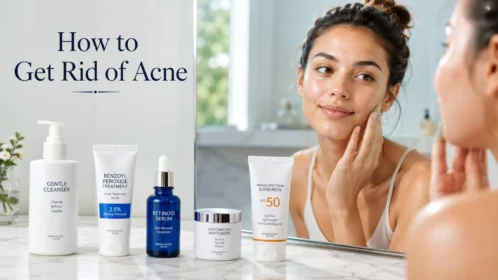
If you’re starting from scratch, here is a routine built on the strong-evidence treatments above, without overwhelming your skin:
Morning: Gentle cleanser, lightweight moisturizer, sunscreen.
Evening: Cleanser, then either a benzoyl peroxide treatment or a retinoid (not both on the same night when you’re starting out, that combination increases irritation risk early on), followed by moisturizer.
Give this 6 to 8 weeks before judging whether it’s working. Skin cell turnover takes time, and most acne treatments need several weeks of consistent use before visible improvement.

When At-Home Treatment Isn’t Enough
If your acne hasn’t improved after 6 to 8 weeks of consistent over-the-counter treatment, it’s time to see a dermatologist rather than keep guessing. This isn’t a failure on your part, some acne genuinely needs prescription-strength treatment.
For more severe or treatment-resistant acne, dermatologists may add oral antibiotics, hormonal treatments like combined oral contraceptives or spironolactone, or in more severe cases, oral isotretinoin. Isotretinoin is considered the only treatment that can almost completely clear severe acne long-term, with around 85% of users seeing permanent clearing, but it requires close medical supervision due to side effects.
For larger, more painful acne bumps, dermatologists sometimes use injectable corticosteroids for faster relief of inflammation and pain, which can be a useful option if you have an important event coming up and one stubborn cystic spot.
Common Mistakes That Make Acne Worse
Over-washing or scrubbing. Scrubbing too hard injures your skin and can actually trigger more breakouts, your instinct to clean harder when breaking out usually backfires.
Combining too many actives at once. Layering benzoyl peroxide, a retinoid, and an acid exfoliant all in the same routine overwhelms your skin barrier and increases irritation without speeding up results.
Switching products too soon. Most acne treatments need 6-8 weeks minimum before you can judge whether they’re working. Switching every 1-2 weeks means you never give anything a fair chance.
Picking or popping. This increases inflammation, the risk of infection, and significantly raises your risk of permanent scarring and dark marks.
Skipping moisturizer because your skin is oily. Effective acne treatment isn’t just about clearing breakouts, it also involves preventing them and a damaged, dehydrated skin barrier often makes acne worse, not better.
Does Diet Affect Acne?
There’s no solid scientific proof that chocolate or greasy food directly causes acne, but research has suggested that reducing sugar and refined carbohydrates may lead to fewer breakouts for some people. If you suspect a dietary link, keeping a simple food diary can help you identify a personal trigger rather than relying on general rules that don’t apply to everyone equally.
Acne Scarring and Dark Marks
Once active acne is under control, leftover dark marks (post-inflammatory hyperpigmentation) or textural scars are a separate issue. For visible scarring, dermatologists may use treatments such as microneedling to boost collagen, subcision to release scar tissue, fillers to lift depressed scars, or chemical peels and lasers to resurface the skin. Dark marks (as opposed to true scars) usually fade on their own over months, and can be sped up with ingredients like azelaic acid or niacinamide.
FAQs
How long does it take to get rid of acne?
With consistent use of evidence-based treatments, most people see meaningful improvement in 6 to 8 weeks. Severe acne treated with prescription options may take 3 to 6 months for full results.
What’s the single most effective acne treatment?
There isn’t one universal answer, it depends on your acne type and severity. Benzoyl peroxide, topical retinoids, topical antibiotics, and oral doxycycline all carry the strongest evidence, and dermatologists often combine more than one.
Can I get rid of acne without seeing a dermatologist?
Mild to moderate acne often responds well to consistent over-the-counter treatment with benzoyl peroxide or a retinoid. If there’s no improvement after 6 to 8 weeks, or if your acne is moderate to severe, seeing a dermatologist is the recommended next step.
Does popping pimples make acne worse?
Yes. It increases inflammation, infection risk, and the chance of permanent scarring or dark marks.
Is acne caused by poor hygiene?
No. Acne is primarily driven by oil production, hormones, and clogged pores — not dirtiness. In fact, scrubbing your face more aggressively can make acne worse, not better. Formula Botanica
Conclusion
Clearing acne isn’t about finding one miracle ingredient, it’s about consistently using treatments with real evidence behind them, giving them enough time to work, and knowing when it’s time to bring in a dermatologist. Start simple, stay consistent for at least 6 to 8 weeks, and escalate to professional care if at-home treatment is not enough.