Why Your Hair Breaking
There’s a particular kind of frustration that comes with hair breakage. You’re not doing anything obviously wrong. You condition regularly. You don’t bleach. You’ve cut down on the heat tools. And yet — there’s still that constant, demoralising snap when you run a comb through, or those short little hairs sticking up around your hairline that definitely weren’t there a year ago.
Most advice about hair breakage stays on the surface. “Use less heat.” “Deep condition more.” “Sleep on silk.” These aren’t wrong — but they’re treating symptoms, not causes. If you want to actually stop breakage, you need to understand what’s happening structurally inside the hair shaft, and which ingredients are genuinely capable of changing that.

What Hair Breaking Actually Is
Hair doesn’t just snap randomly. Before a strand breaks, something has already failed at the structural level — and understanding what failed is the key to preventing it.
Each strand of your hair is made up of three layers. The medulla is the soft inner core. The cortex is the thick middle layer — it contains most of the hair’s protein (keratin), pigment, and structural integrity. The cuticle is the outer protective layer — those overlapping scale-like cells you’ll see in microscope images of hair, lying flat when hair is healthy, raised and rough when it’s damaged.
Breakage happens when the cortex loses enough structural integrity that normal mechanical stress — combing, styling, even just sleeping on it — exceeds what the strand can handle. The cuticle damage usually comes first, exposing the cortex. Then, without that protection, moisture escapes, proteins degrade, and the cortex becomes brittle.
Breakage isn’t a single event. It’s the endpoint of a process that started much earlier — usually with cuticle disruption, then moisture loss, then protein degradation. Fix the earliest stage and you prevent the last one.
The Three Real Causes of Hair Breakage
Most breakage falls into one of three categories — and plenty of people are dealing with all three at the same time.
1. Protein-Moisture Imbalance
Hair needs both protein and moisture to stay flexible and strong. Too little protein and the strand becomes weak and overly elastic — it stretches too far and snaps. Too little moisture and it becomes brittle — it can’t flex at all and fractures under stress.
Most people with breakage are either protein-deficient or moisture-deficient, and treating the wrong one makes things worse.
The simple test: Take a wet strand and gently stretch it.
- Stretches a lot before breaking → you’re likely moisture-deficient
- Snaps with very little stretch → you’re likely protein-deficient
- Stretches a little then breaks cleanly → you’re in reasonable balance
2. Mechanical Stress Accumulation
Every time you brush, comb, or manipulate your hair, you create micro-stress in the strand. Healthy hair handles this easily. But hair that’s slightly dehydrated, swollen from product buildup, or has raised cuticles from alkaline products accumulates that stress much faster. Over weeks, the damage compounds — and then one ordinary brush stroke becomes the last straw.
This is why breakage often seems to get suddenly worse rather than building gradually. It’s not sudden — the damage was accumulating invisibly the whole time.
3. Chemical and Environmental Damage
Colour treatments, relaxers, perms, and even chlorinated swimming pools disrupt the disulfide bonds that hold keratin proteins together. UV exposure degrades the amino acids in the cortex. Hard water deposits minerals that interfere with moisture absorption.
These aren’t rare edge cases — most people with ongoing breakage have at least one of these factors actively working against them.
Is It Breakage or Shedding? (This Matters)
Before going further — make sure you’re actually dealing with breakage, because the treatments are completely different.
Shedding is natural. You lose 50–100 hairs per day from the root. You’ll see a small white or clear bulb at the end of shed hairs. If most of the hair you’re losing has a bulb, focus on scalp health, not breakage treatments.
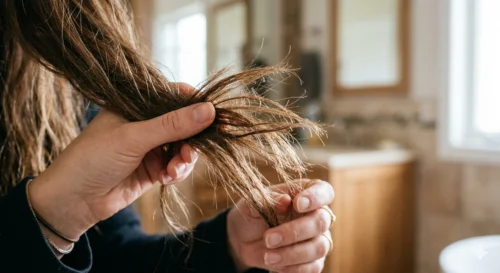
Breakage produces shorter strands with no bulb — the hair is snapping somewhere along the shaft, not falling from the root. Varying lengths, no bulb, and hair that’s shorter than your usual growth? That’s breakage.
Getting this distinction right saves you weeks of treating the wrong problem.
The Ingredients That Actually Target Breakage
Not all conditioning ingredients are equal when it comes to breakage specifically. Some coat the hair surface. Some smooth the cuticle. But a smaller group actually work at the cortex level — rebuilding or protecting the structural proteins that prevent breakage in the first place. These are the ones worth knowing.
Hydrolyzed Keratin (Protein Treatment)
Small keratin fragments that can penetrate the cortex and temporarily fill in structural gaps caused by chemical processing or heat damage. Works best when protein loss is the primary issue. Look for it in the top five ingredients — if it’s near the bottom of the list, the concentration is too low to do meaningful work.
D-Panthenol / Provitamin B5 (Penetrating Conditioner)
One of the few ingredients that genuinely penetrates the hair shaft rather than just sitting on the surface. It improves moisture retention and elasticity from within — directly targeting the brittleness that leads to breakage. You can read more in our D-Panthenol guide.
Bis-Aminopropyl Diglycol Dimaleate (Bond Strengthener)
The active ingredient behind professional bond-repair treatments. It works by cross-linking broken disulfide bonds in the cortex — one of the only ingredients that actually addresses chemical damage at the structural level rather than just masking it.
Crodabond CSA (Cuticle Smoother)
Specifically designed to smooth raised cuticles and address split ends, reducing the mechanical friction that compounds breakage over time. Particularly useful as part of a dual approach — treating both the cause and the surface damage simultaneously. See our Crodabond CSA guide.
Keravis (Strengthening Complex)
A plant-based protein hydrolysate derived from wheat that targets the hair’s internal structure. Clinically studied for reducing breakage during combing — which is one of the highest mechanical stress events your hair experiences daily. Full Keravis guide here.
Keradeep (Deep Repair Active)
Designed for deeply compromised hair — works on the cortex to reinforce structural integrity from within, not just at the surface. Best suited for chronically brittle or over-processed hair where surface treatments alone aren’t cutting it. See Keradeep.
Why “Just Conditioning More” Often Doesn’t Work
Standard conditioners smooth the cuticle, reduce friction, and add surface moisture. They’re good at what they do — but if your breakage is coming from protein depletion or internal cortex damage, surface conditioning is like painting over a crack in a wall. The structural problem is still there underneath.
Conditioning is maintenance. But if breakage is already happening, you’re past maintenance — you need ingredients that can actually work on the cortex, not just the surface.
This is especially true for anyone who’s been over-conditioning without protein. Excessive moisture without protein creates hygral fatigue — the repeated swelling and contracting of the hair shaft from moisture cycling, which actually accelerates breakage.
If your hair feels mushy when wet, stretches a lot without springing back, and still breaks frequently — you may be over-moisturised and protein-deficient simultaneously. Adding more conditioner won’t fix it.
What to Look For on Product Labels
The gap between marketing claims and actual ingredients is wide in hair care. Here’s what to check on the INCI ingredient list — not the front-of-pack claims:
If your breakage is from chemical processing: Look for Bis-Aminopropyl Diglycol Dimaleate, hydrolyzed keratin, amino acids. Avoid high-alkaline products and sulfate shampoos immediately post-treatment.
If your breakage is from dryness and moisture loss: Look for Panthenol, Sodium PCA, Glycerin, Betaine. Avoid drying alcohols (listed as Alcohol Denat.) and very high protein treatments.
If your breakage is from mechanical friction: Look for Cetrimonium Chloride, Behentrimonium Methosulfate, Dimethicone, Amodimethicone. Avoid rough towel drying and fine-tooth combs on wet hair.
If your breakage is from protein deficiency: Look for Hydrolyzed Wheat Protein, Hydrolyzed Silk, Hydrolyzed Keratin, Quinoa Protein in the top five ingredients. Avoid completely protein-free product routines over extended periods.
The Breakage Cycle Most People Are Stuck In
Here’s something that doesn’t get discussed enough: breakage creates more breakage.
When a strand snaps, the broken end is rough and jagged. That rough end catches on adjacent strands, raising their cuticles, increasing friction, and accelerating their own damage. This is why once breakage starts it tends to get progressively worse if you don’t intervene — and why just “being gentler” usually isn’t enough on its own.
Breaking the cycle requires addressing both the cause (protein-moisture balance, chemical damage) and the symptom (rough cuticles, increased friction). Ingredients like those in Lustreplex are specifically formulated for this dual action — smoothing the cuticle surface while the underlying structural issue is being addressed.
Building a Breakage-Prevention Routine
There’s no single universal routine because breakage has different causes for different people. But this framework works for most people once they’ve identified their breakage type:
- Do the wet stretch test first — establish whether you’re protein-deficient or moisture-deficient before starting any treatment
- If protein-deficient: use a penetrating protein treatment with hydrolyzed keratin or wheat protein in the top five ingredients, once every 1–2 weeks
- Always follow a protein treatment with moisture — protein alone without moisture creates its own brittleness
- Use a leave-in conditioner with Panthenol or Sodium PCA for daily moisture maintenance between treatments
- Detangle only on wet, conditioned hair with a wide-tooth comb — starting from the ends and working upward
- If chemically treated: use bond-repair treatments consistently for a minimum of 8 weeks before assessing results
- Reassess monthly — the right protein-moisture balance shifts as your hair grows and seasonal conditions change
When to See a Trichologist
If you’ve addressed protein-moisture balance, reduced mechanical stress, and used targeted ingredients consistently for 8–12 weeks without meaningful improvement — or if breakage is accompanied by significant overall thinning, scalp changes, or sudden onset — it’s worth seeing a trichologist or dermatologist.
Some breakage has underlying causes — hormonal shifts, nutritional deficiencies, autoimmune conditions — that no topical ingredient will resolve on its own. There’s no shame in ruling those out, and getting the right diagnosis early saves months of ineffective trial and error.
Frequently Asked Questions
Why does my hair break so easily even though I condition it?
Conditioning alone only addresses the surface of the hair strand. If your breakage is caused by protein depletion — from chemical processing, heat, or just wear over time — standard conditioners won’t fix it. They don’t penetrate the cortex where the structural damage is happening. You likely need a protein treatment with hydrolyzed keratin or wheat protein, followed by moisture to prevent protein-induced brittleness.
What is the difference between hair breakage and hair loss?
Hair loss (shedding) occurs at the root — you’ll see a small white or clear bulb at the end of each shed hair. Breakage happens somewhere along the shaft — the strands are shorter and have no bulb. They have completely different causes. Shedding relates to the hair growth cycle and scalp health. Breakage relates to the structural integrity of the strand itself.
Can broken hair actually be repaired, or does it just need to be cut?
Once a strand has broken, that specific break can’t be undone. But the remaining hair can absolutely be improved to prevent further breakage. Bond-repair ingredients can cross-link damaged disulfide bonds. Protein treatments fill structural gaps. Cuticle-smoothing ingredients reduce the friction that accelerates the problem. Trimming split ends still helps, but targeted treatment changes the trajectory of your hair health overall.
How long does it take to see results from breakage treatments?
Most people notice reduced breakage — less hair on the brush, fewer snaps when combing — within 4–8 weeks of consistent use. Full improvement takes longer because damaged hair grows out gradually. The new growth coming in reflects your current hair health, while existing damaged sections improve more slowly. Give any breakage intervention a minimum of 8 weeks before judging whether it’s working.
Is heat damage the main cause of hair breakage?
Heat damage is significant — it denatures cortex proteins and disrupts the cuticle — but it’s not the only cause, and often not the primary one. Protein-moisture imbalance, chemical processing, mechanical stress from brushing, and even hard water mineral deposits all cause breakage independently of heat. Many people reduce their heat tool use and see very limited improvement because something else is actually the main culprit.
Does hair type affect how prone you are to breakage?
Yes, significantly. Coily and tightly-curled hair types have more natural curl points in each strand, and each curl point is a structural weak spot. This makes type 4 hair inherently more susceptible to mechanical breakage than straight hair under the same conditions. The detangling process requires more care, and moisture retention is harder because the cuticle pattern makes the strand less smooth overall.