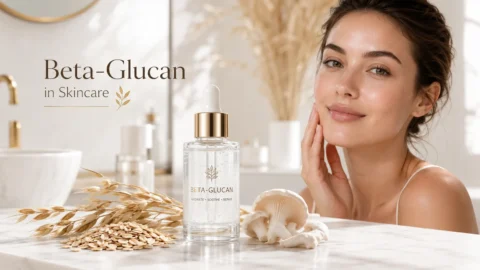
Beta-Glucan in Skincare:
Every few years, a skincare ingredient makes the jump from the back of a formula to the front of a label, from a background player to a headline ingredient. In 2026, that ingredient is beta glucan. Searches for it have grown 181% year-on-year, and it’s appearing in product launches from Korean skincare giants to European pharmacy brands and indie formulators across South Asia.
The interesting thing is that beta-glucan isn’t new. It has been studied for decades in medicine, and its water-soluble cosmetic form has been in professional skincare since 1994. What’s changed is that consumers are finally looking for it by name, because it solves real, common skin problems with a level of clinical evidence that most trending ingredients can’t match.
Here is everything you need to know about beta-glucan: what it is, what the science actually confirms, how it compares to ingredients you already know, and how to incorporate it into your routine.

What Is Beta-Glucan?
Beta-glucan is a molecule that comes from natural sources like bacteria, yeast, and plants and is used in skincare because of its hydrating and antibacterial properties. More specifically, it is a natural polysaccharide, a type of long-chain sugar molecule, widely found in plants, fungi, bacteria, and algae.
Yeast is the source that has been most extensively studied from a scientific and pharmacological perspective. Beta-glucan derived from the cell wall of baker’s yeast has been used for decades in oral applications as an immunostimulant. In cosmetics, oat-derived beta-glucan (from oat bran) is also widely used and is the form most commonly found in sensitive-skin and barrier-repair formulas.
The key development that brought beta-glucan into cosmetics happened in 1994. Mibelle Biochemistry succeeded in developing a water-soluble version of beta-glucan suitable for topical applications: CM-Glucan. Numerous clinical studies have demonstrated the benefits of CM-Glucan on either very sensitive skin or skin exposed to extreme stress, such as following aesthetic procedures.
Today, due to its significant immunomodulatory effects, it has become an important source for functional foods and pharmaceuticals. In addition to immune regulation, beta-glucan also exhibits various bioactivities, including antioxidant, anti-inflammatory, barrier repair, and moisturizing effects, demonstrating great potential for applications in skincare.
What Beta-Glucan Does for Your Skin
Beta-glucan, as a natural polysaccharide, possesses significant biological activity and shows broad application potential in the field of skincare. Its main functions include immune modulation, antioxidant, anti-inflammatory, skin barrier repair, and moisturizing, all of which have been validated through numerous clinical and basic research studies.
That’s a wide range of benefits from a single ingredient. Here’s what each one actually means at the skin level:
Deep hydration. Beta-glucan is a powerful humectant, it draws moisture from the environment and from deeper skin layers up to the surface, similar to hyaluronic acid. Beta-glucan is a known humectant that helps boost the skin barrier with hydration, making it a valuable component of skincare products for sensitive skin types. In clinical testing, subjects using beta-glucan skincare showed significantly improved skin hydration and reduced transepidermal water loss at both day 7 and day 14 of use.
Barrier repair and strengthening. This is where beta-glucan’s real strength lies over simple hydrating ingredients. It doesn’t just add moisture to the surface — it actively helps repair the skin’s protective barrier, which controls how much moisture stays in and how many irritants get through. Beta-glucan can help minimize redness, soothe inflammation or sensitivity, and strengthen the skin barrier.
Anti-inflammatory and soothing. Beta-glucans are thought to have antioxidant and anti-inflammatory effects on the skin, which makes the ingredient very favorable to our immune systems. This makes it particularly well-suited for reactive, sensitive, or post-procedure skin that needs calming rather than stimulation.
Wound healing support. Beta-glucans have been shown to help promote wound healing by enhancing the skin’s natural repair process. This property is why beta-glucan skincare regimens have been studied specifically in people recovering from laser treatments, where the skin needs to repair quickly with minimal inflammation.
Antioxidant protection. Beta-glucans have antioxidant properties that can mitigate the aging effects of oxidative stresses like sun damage, which is ideal if you’re looking to reduce the appearance of fine lines and wrinkles.

The Clinical Evidence Behind Beta-Glucan
Unlike many trending skincare ingredients whose benefits are largely based on in-vitro lab studies or theoretical mechanisms, beta-glucan has a meaningful body of clinical evidence behind it.
A study evaluated the impact of a beta-glucan-containing skincare regimen on recovery after laser treatment. In 20 patients with facial acne scars undergoing CO2 fractional laser or 1565 nm non-ablative laser treatment, the left side of the face was treated with the beta-glucan skincare regimen, while the right side served as the control. The results showed that the treatment group exhibited significantly improved hemoglobin indices on Day 7, as well as better skin hydration and reduced transepidermal water loss on both Day 7 and Day 14. Moreover, 63.2% of patients self-reported better outcomes with the skincare regimen, with no significant side effects observed.
This split-face study design is particularly persuasive because each patient serves as their own control — the difference in outcomes between the treated and untreated sides of the same face eliminates most variables that typically complicate skincare research.
Existing studies suggest that beta-glucan demonstrates positive effects in the treatment of skin issues such as wound healing, atopic dermatitis, photoaging, and ultraviolet (UV) damage.
An active clinical trial at the University of Alberta (2026) is currently evaluating beta-glucan cream specifically as a hydrating and soothing agent for skin repair — further confirmation that the medical community’s interest in this ingredient goes beyond cosmetic trends.
Beta-Glucan vs Hyaluronic Acid: Which Is Better?
This is the comparison that comes up most often because both are humectants — ingredients that draw and hold moisture in the skin. The honest answer is that they’re not competitors, they’re complementary.
Hyaluronic acid provides immediate hydration, while beta-glucan strengthens the skin’s resilience and its ability to retain moisture over the long term. So instead of asking which is better, the right question is: what does your skin need right now? nih
If you need fast, visible hydration — the kind that plumps skin immediately — hyaluronic acid delivers that more quickly. If you need to rebuild your skin’s capacity to hold onto moisture over time, reduce sensitivity, and strengthen the barrier, beta-glucan works at a deeper structural level that hyaluronic acid doesn’t address.
In practical terms, instead of wondering whether beta-glucan is better than hyaluronic acid, take advantage of both ingredients and give your skin a short-term and long-term solution for hydration. The two work well in the same routine and are frequently formulated together in barrier-focused skincare products. nih
Who Should Use Beta-Glucan?
Beta-glucan’s most significant advantage over many active ingredients is its suitability across skin types, including those that can’t tolerate stronger actives.
Sensitive and reactive skin. This is beta-glucan’s strongest use case. Its anti-inflammatory mechanism specifically helps calm overreactive skin responses, and its barrier-strengthening properties address the root cause of sensitivity rather than just soothing the surface.
Compromised skin barriers. If you’ve been overusing actives — retinol, AHAs, strong vitamin C — and your skin feels tight, reactive, or stripped, beta-glucan is one of the most evidence-backed ingredients for barrier recovery.
Post-procedure recovery. The clinical evidence specifically supports beta-glucan after laser treatments, chemical peels, and microneedling. If you’ve had any cosmetic procedure, a beta-glucan-containing product during the recovery phase is a well-supported choice.
Aging skin. The antioxidant and anti-inflammatory properties make beta-glucan useful for addressing the early signs of photoaging — sun damage and environmental oxidative stress that accumulate over years of UV exposure in climates like Pakistan’s.
Oily and acne-prone skin. Because it is lightweight and non-comedogenic, beta-glucan provides hydration without adding oil, making it one of the few deeply hydrating ingredients that oily skin types can use without concern about pore-clogging.
Normal skin. There is essentially no skin type that doesn’t benefit from barrier support and antioxidant protection. Beta-glucan’s gentle profile means it is genuinely suitable for anyone.
How Does Beta-Glucan Fit Into 2026 Skincare?
In 2026, not only are we well acquainted with ingredients like hyaluronic acid, niacinamide, retinol, and snail mucin, but we also know exactly how to combine them, layer them, and incorporate them into our skincare routine. Beta-glucan fits perfectly into that context — found in product formulas, but rarely taking the leading role. nih
As interest in barrier repair and inflammation-modulating actives grows, beta-glucan is receiving renewed attention — not as a trend ingredient, but as a molecule supported by reproducible, peer-reviewed research.
If you like to sort skincare ingredients into mental categories, you can place beta-glucan alongside ectoin, ceramides, and allantoin — ingredients known for their soothing properties and ability to reduce inflammatory processes. This categorization is useful because it tells you what beta-glucan is for: repair and protection, not correction. It is a supporting ingredient in the best sense — one that makes everything else in your routine work better by keeping your barrier healthy. nih
How to Use Beta-Glucan in Your Routine
Beta-glucan is one of the most low-maintenance ingredients to incorporate because it is gentle enough to use morning and evening, has no known interactions with other common actives, and works across all skin types without adjustment periods.
Where it fits in your routine: Apply beta-glucan serum or essence after cleansing and toning, before heavier creams or oils. Because it is a humectant, it works best applied to slightly damp skin where it can draw in available moisture.
Morning use: Pair with vitamin C (for antioxidant synergy) and always follow with SPF. Beta-glucan does not increase photosensitivity the way AHAs or retinol do, so it can be used freely in the morning without the same caution those ingredients require.
Evening use: Works well alongside retinol and niacinamide. If you are introducing retinol and experiencing irritation, adding a beta-glucan serum to your routine is a well-supported strategy for reducing that irritation while keeping the retinol in play.
After procedures: If you have had a chemical peel, laser treatment, or microneedling, incorporate a beta-glucan product from the first day of recovery. The evidence specifically supports its use in this context for reducing downtime and improving healing outcomes.
Format guidance: Beta-glucan appears in serums, essences, moisturizers, and sheet masks. Serums and leave-on essences deliver the most consistent dose. Moisturizers with beta-glucan as a secondary ingredient are useful but typically contain lower concentrations. Sheet masks are a useful occasional treatment, especially during skin recovery phases.

What to Look for on the Label
Beta-glucan appears in ingredient lists under several INCI names depending on the source:
Beta-Glucan — the most common listing, typically oat-derived
Sodium Carboxymethyl Beta-Glucan — the water-soluble yeast-derived CM-Glucan developed by Mibelle Biochemistry, the most clinically studied form
Avena Sativa (Oat) Kernel Extract — oat-derived beta-glucan within a full oat extract
Look for it in the first half of the ingredient list for meaningful concentrations. If it appears near the end, it is present at trace levels that are unlikely to deliver the full barrier and soothing benefits the research supports.
Common Questions About Beta-Glucan
Is beta-glucan safe for all skin types?
Yes. Beta-glucan has no known irritation potential and is non-comedogenic. It is one of the few active ingredients consistently described by dermatologists as suitable for every skin type, including the most sensitive.
Can I use beta-glucan with retinol?
Yes, and it’s a pairing actively recommended for people who find retinol irritating. Beta-glucan’s barrier-supporting and anti-inflammatory properties can help counterbalance retinol’s drying and sensitizing effects.
How long does beta-glucan take to show results?
Hydration improvement is often noticeable within days. Barrier strengthening and reduced sensitivity are typically observable within two to four weeks of consistent use.
Is beta-glucan the same as oat extract in skincare?
Oat extract is a common source of beta-glucan, but not all oat extracts are standardized for beta-glucan content. Products specifically listing beta-glucan or CM-glucan as an ingredient deliver a more consistent, measurable dose than those using general oat extract.
Can I use beta-glucan if I have eczema or atopic dermatitis?
The clinical evidence actually supports beta-glucan use in atopic dermatitis specifically. However, if you have an active flare or a diagnosed skin condition, consult a dermatologist before adding any new ingredient.
Does beta-glucan replace hyaluronic acid?
No — it complements it. Use both for a short-term and long-term hydration strategy: hyaluronic acid for immediate plumping, beta-glucan for sustained barrier strength and moisture retention.
Conclusion
Beta-glucan is not a trend ingredient built on marketing language. It is a molecule with decades of pharmaceutical research behind it, clinical evidence from split-face studies, and a safety profile that makes it one of the most accessible active ingredients in skincare regardless of skin type. In 2026, as the skincare conversation moves away from aggressive exfoliation and towards barrier intelligence, beta-glucan is exactly the kind of ingredient that deserves the attention it is finally receiving.
About the Author
Muhammad Muddassir
Cosmetic Formulation Specialist · Founder, CosmeTechs
Five years of hands-on R&D across skincare, haircare, and body care — from lab-scale development through industrial production. Specialised in emulsion technology, formula troubleshooting, and scale-up consulting for brands targeting Pakistan, GCC, and international markets.